
White Stains and Crumbling Brick: What Your Wall Is Telling You
A chalky white bloom on brickwork and a face that flakes off are two different problems with one thing in common. Water is moving through the wall, and the wall is telling you where.
The white powder is efflorescence: salts left behind when water passes through masonry and evaporates at the surface. It is a symptom, not a disease, and it comes back until the water source is fixed. Brick that is flaking or breaking away is spalling, and that is active damage. Cleaning either one without finding the water is a waste of a weekend.
These two show up together on NYC buildings constantly, usually on a north facing wall, under a parapet, or along the bottom few courses near the ground. Here is how to read them.
What efflorescence actually is
Brick, block and mortar all contain soluble salts. When water gets into the wall it dissolves those salts and carries them along. When that water reaches the surface and evaporates, the salts are left behind as a white or grey deposit.
So efflorescence is proof of two things at once: there is water inside the wall, and it is finding a way out through the face. On a new building it can appear in the first year and then stop, which is normal. On an older wall that has been dry for decades and suddenly blooms, something has changed. A gutter, a coping stone, a roof detail, or joints that have finally opened up.
Efflorescence, spalling and mortar failure
People use these words interchangeably and they are not the same thing. Sorting them out decides what work is actually needed.
- Efflorescence sits on the surface and can be brushed. The brick underneath is intact.
- Spalling means the face of the brick itself is breaking away in flakes or chunks. That is permanent, and each spalled brick lets in more water.
- Mortar failure is the joint turning soft, powdery or recessed. It is usually the entry point that caused the other two.
Most walls we survey have all three, in that order of severity, and the fix starts at the joints.
Efflorescence
White bloom on the surface. Brushes off. Tells you water is moving through the wall, but the brick is still sound.
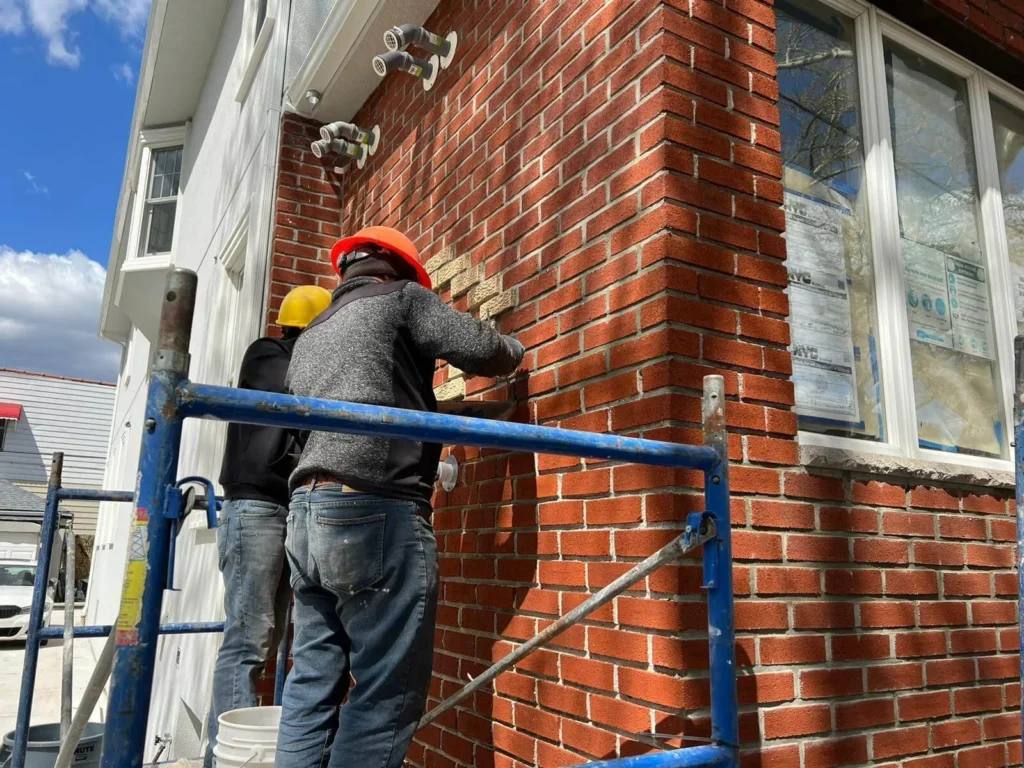
Open mortar joints
Soft, crumbling or recessed joints. This is where the water is entering, and it will keep entering until the joints are cut out and replaced.
Spalled brick
The face has broken away. That brick cannot be repaired, only cut out and replaced with a match.
Where the water is getting in
On NYC buildings it is nearly always one of a short list, and it is nearly always above the stain rather than behind it.
- Parapet and coping. The most exposed part of any building, and open coping joints send water straight down inside the wall.
- Roof drainage. A blocked scupper or drain backs water onto the roof and into the wall head.
- Failed pointing. Open joints anywhere on the elevation, particularly on the weather side.
- Window sills and lintels. Sills that have lost their slope, and rusting steel lintels that push the brickwork apart.
- Ground level. Splashback from a sidewalk or planting bed, and paving that has been raised above the damp course.
That is why we look at the top of a wall when someone points at a stain near the bottom. Water travels.
Before you reach for the acid
Muriatic acid is the standard advice on the internet and it causes a lot of the damage we repair. Used wrongly it burns the brick face, attacks the mortar and leaves behind more salts, which means more efflorescence a few months later. Start with a dry stiff brush, then plain water, and keep anything stronger for a professional who will test a patch first.
Why sealing the wall usually backfires
The instinct is to seal the brick so water stops getting in. On a wall that already has water inside it, a film forming sealer does the opposite of what you wanted. Moisture still enters through the joints, the roof and the parapet, and now it cannot evaporate through the face.
It exits through whatever is weakest instead, which is usually the brick face. That is how a sealed wall goes from mild efflorescence to visible spalling in a couple of winters. Fix the entry points first. If a coating is used at all, it has to be breathable.
What the repair actually involves
Once the water source is identified, the work runs in a set order, because doing it out of order wastes money.
- Stop the water at the top. Coping, flashing, roof drainage and sills come first. Nothing below matters until this is done.
- Cut out and replace failed joints. Proper depth, matched mix and profile. This is the core of any brick pointing job.
- Replace spalled brick. Individual units cut out and matched for size, colour and texture.
- Let the wall dry, then clean. Efflorescence keeps returning while the wall is still wet inside, so cleaning goes last.
On larger buildings this often forms part of a wider facade restoration, and if the building is over six stories it may already be tied to a facade inspection cycle. Our guide to FISP Cycle 10 covers what that means for owners.
Frequently asked questions
Is efflorescence dangerous?
Will efflorescence go away on its own?
Can spalled brick be repaired?
Should I seal my brick wall?
Can I clean the white stains myself?
How do I know if it is just staining or real damage?
Seeing white bloom or flaking brick on your building? Send us a photo of the wall and one of the roofline above it. We will tell you where the water is most likely entering, and the estimate is free across all five boroughs and Westchester. Call (917) 415-1383, message us on WhatsApp, or email contact@brickpointing-nyc.com.